About
Kaleidoscope Systems is a body of work — courses, writing, and frameworks — about minds, systems, and care. It exists because the people who can see the whole pattern deserve tools that fit how they think.
What we are
Kaleidoscope Systems is a neurodiversity-informed learning ecosystem — a home for people who think in whole systems and were often told that was a problem.
We help individuals, communities, and organizations navigate complexity through systems thinking, transformative learning, and human-centered design — offering courses, consulting, publications, and community-based learning grounded in cognitive ecology, accessibility, and leadership development.
Our premise: many of the challenges people and organizations face aren't simply personal or technical, but relational and systemic. By helping people recognize patterns, bridge differences, and build environments where diverse minds thrive, we work toward more adaptive, compassionate, and resilient communities.
Kaleidoscope Systems isn't a clinical or diagnostic place. When we say neurodivergent, we mostly mean constitutive neurodivergence — the lasting, built-in ways a mind is wired, like autism, ADHD, giftedness, or plurality. We treat these as differences to understand and support, not deficits to fix. This doesn't dismiss trauma or acquired difference — those are real too — it just keeps them from being collapsed into one another, so no one loses access or credibility in the blur.
The story
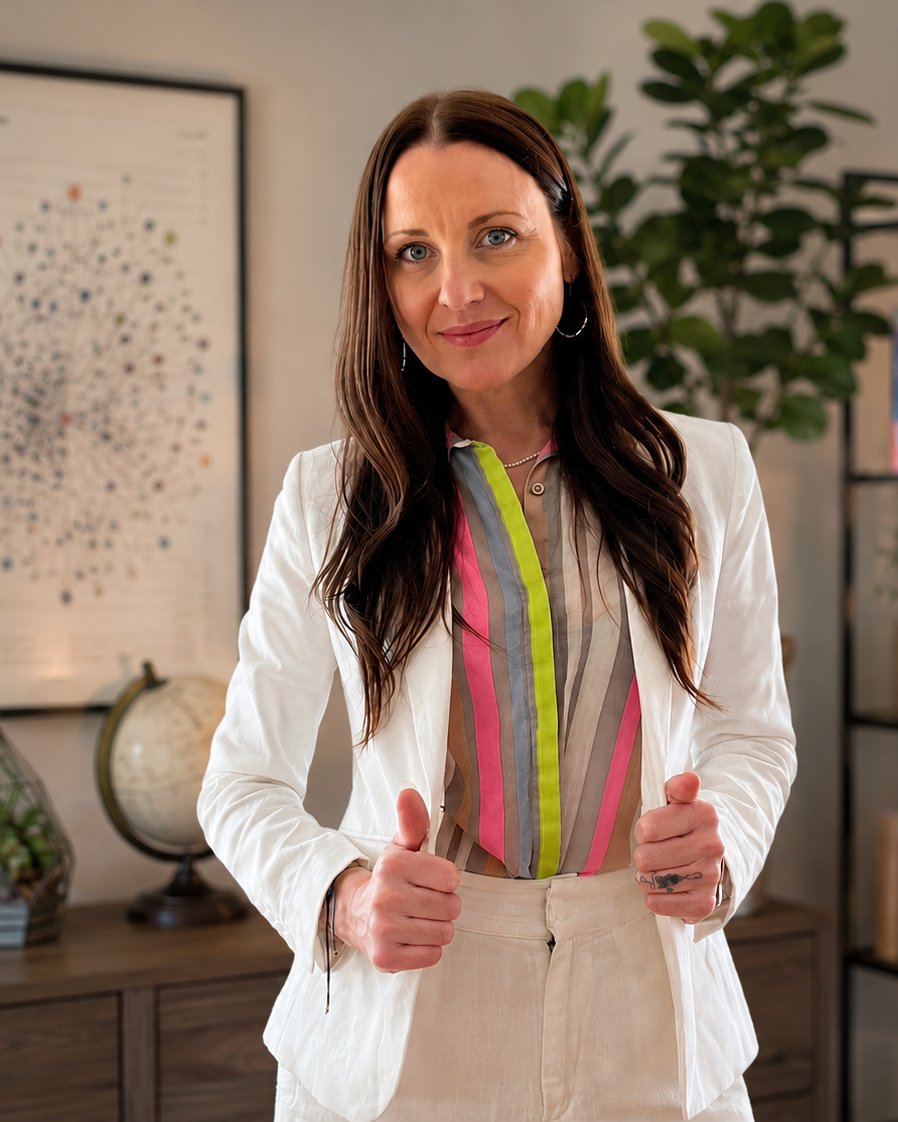
I'm Sher Griffin — a writer, educator, and cognitive ecologist. For a long time I carried something that felt like a personal failing: I could feel the dynamics in any room, the tensions in any organization, the patterns running underneath what people were actually saying — and I had no way to name any of it. So I assumed the problem was me. Too sensitive. Too much. Overthinking.
What I was actually missing was a map. A way to tell the difference between myself and the systems I was standing inside of — to see that the hard days were often information about a structure, not a verdict on my worth.
When I finally found that way of seeing, everything changed. I stopped mistaking the shape of the room for a flaw in myself. I could see where I stood, what was mine to carry and what wasn't, and — for the first time — where I might actually push to make something better.
Kaleidoscope Systems is the map I wish someone had handed me. My work braids together cognitive science, lived experience, and design so that people who have always been misread by systems can understand them, move through them with more freedom, and build new ones that fit more kinds of minds.
What I bring to it
I don't lead with credentials, because the lived experience came first and matters more. But it's fair to know where the work is grounded. I've been building and transforming organizational systems since 2009 — operations and HR leadership, program direction in statewide advocacy, and behavioral health systems transformation as a senior project manager for the State of Oregon. That's the practical half. The scholarly half: I hold an MA in Transformative Social Change and am pursuing a doctorate in the same field, expected 2027. My master's thesis introduced the Cognitive Ecology Model, and my dissertation studies identity development in post-developmental autistic women. I've also spent years running peer support groups for late-identified autistic adults, and I write in public — over 700 essays — where the thinking gets tested by the people it's about.
Scholarly rigour
Research foregrounded and cited, so you can check me.
Systems literacy
Fifteen years inside real institutions, not just theorising about them.
Lived experience
Late-identified autistic, ADHD, and gifted. This is my own terrain.
A commons, not a brand
The model is uncopyrightable by design, and its lineage is named.
The frameworks
Everything I teach grows from a few original frameworks — the intellectual backbone of the whole ecosystem.
Understanding people through context, relationships, and environments — as living systems, not deficits to fix.
The integration of reflection, embodiment, systems awareness, and collective action into one practical whole.
How exclusionary systems form self-reinforcing loops — and where it's possible to intervene.
Seeing giftedness and neurodivergence as ecological phenomena — about fit and context, not fixed individual traits.
What guides the work
Questions before judgments. Always.
People are never problems to be solved.
Built for many minds from the start.
Nothing real happens in isolation.
How the site is built
Accommodation is the exception you have to ask for. Accessibility is a system that flexes so you don't have to. The disability-justice writer Mia Mingus named a third thing — access intimacy: the felt sense of someone simply getting your access needs, without the labor of explaining or managing their discomfort. The difference between being let in and being met.
Who's here
These aren't scores to beat — they're a picture of who this reaches and how much has been made. The work isn't measured by the numbers; the numbers are just where the people are.
Not open yet
Thirty-seven courses are written. What is not finished is the part that lets you have an account, keep your place, and be in a room with other people. That is being built now.